
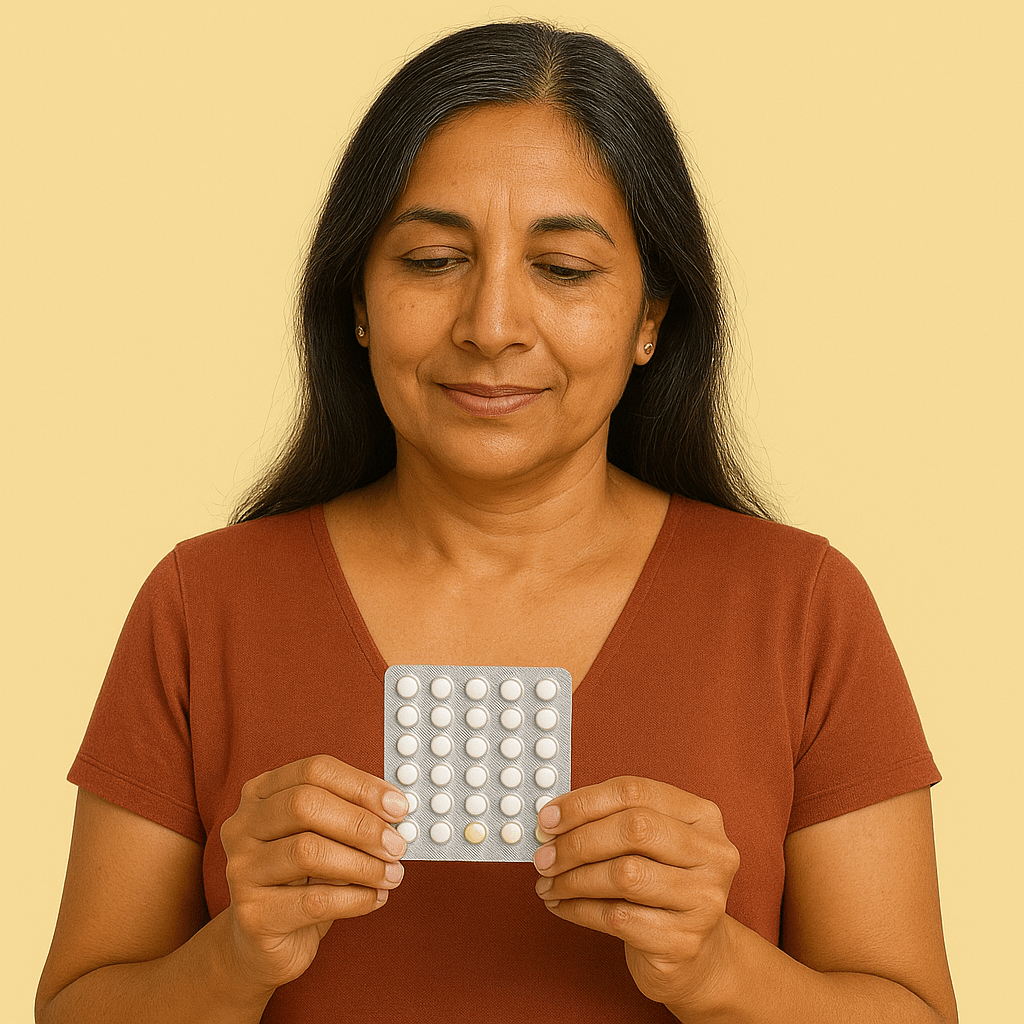
You’re in your 40s, dealing with irregular periods, surprise hot flashes, and mood swings that came out of nowhere—and you’re also still trying not to get pregnant. It’s a frustrating combination that many women face during perimenopause, and it raises a question you might not have expected: should you go back on the pill?
Here’s something that surprises many women: the contraceptive pill for perimenopause isn’t just about preventing pregnancy. It can actually help manage the symptoms that are making your life difficult—the unpredictable bleeding, the hot flashes, the hormonal chaos. For the right candidates, it’s a two-in-one solution.
But the pill isn’t appropriate for everyone, and there are important factors to consider as you get older. This guide breaks down everything you need to know: how the pill helps, who should (and shouldn’t) take it, how it compares to HRT, and when it might be time to make a switch.
Can You Take the Contraceptive Pill During Perimenopause?
Yes—for many women, combined oral contraceptives remain a safe and effective option well into their 40s and even early 50s.
According to CDC Medical Eligibility Criteria, age alone is not a contraindication for combined hormonal contraceptives. For healthy, non-smoking women without cardiovascular risk factors, the CDC classifies combined pills as Category 2—meaning the benefits generally outweigh the risks.
The key word here is “healthy.” Your eligibility depends on factors like blood pressure, smoking status, weight, and medical history rather than your age. We’ll get into the specifics of who should avoid the pill shortly.
What makes the pill particularly useful during perimenopause is how it works. During this transition, your hormones aren’t declining smoothly—they’re fluctuating wildly, sometimes spiking higher than normal before crashing. The pill essentially overrides this chaos, providing steady, predictable hormone levels. That stability is what helps with symptoms.
Today’s low-dose formulations contain significantly less estrogen than older versions (typically 15-35 mcg of ethinyl estradiol, compared to 100+ mcg in pills from decades ago), which reduces risks while still providing benefits.
How the Contraceptive Pill Helps Perimenopause Symptoms
The pill does more than prevent pregnancy. Here’s how it can help with specific perimenopause challenges:
Regulates Irregular Periods
One of the most frustrating aspects of perimenopause is never knowing when your period will show up—or how long it’ll last when it does. The pill takes control of your cycle, giving you predictable bleeding (or no bleeding at all, if you choose a continuous regimen).
Your doctor may recommend different approaches depending on your situation. Traditional regimens include 21 days of active pills followed by 7 inactive days. But many perimenopausal women do better with extended regimens (taking active pills for 84 days with only occasional breaks) or continuous use (skipping the placebo week entirely). Fewer hormone-free intervals mean fewer opportunities for breakthrough symptoms.
Reduces Heavy Menstrual Bleeding
Heavy, prolonged periods are extremely common in perimenopause—often caused by anovulatory cycles where your uterine lining builds up more than usual. This can lead to anemia and significantly impact your quality of life.
Research published in the Journal of Menopausal Medicine confirms that combined oral contraceptives offer excellent control of bleeding timing and reduction in bleeding quantity. Continuous or extended regimens tend to be most effective for minimizing blood loss.
Eases Hot Flashes and Night Sweats
Approximately 70-80% of perimenopausal women experience vasomotor symptoms—hot flashes and night sweats. The pill can help by preventing the hormone dips that trigger these episodes.
One three-year observational study found that 90% of perimenopausal women with vasomotor symptoms experienced relief with combined oral contraceptive therapy, compared to just 40% with placebo. Extended or continuous use may be even more effective since you’re not experiencing hormone withdrawal during a placebo week.
Other Benefits
The pill offers several additional advantages during perimenopause:
- Bone health: Estrogen helps prevent bone loss, which accelerates during the menopausal transition
- Menstrual pain relief: Dysmenorrhea often worsens in perimenopause; the pill can help
- PMS symptom improvement: Many women find PMS intensifies during perimenopause
- Cancer risk reduction: Combined oral contraceptives can reduce the risk of endometrial cancer by about 50% and also lower ovarian and colorectal cancer risk—protection that lasts for decades after stopping
- Acne improvement: Hormonal acne can flare during perimenopause due to shifting androgen ratios
Types of Contraceptive Pills for Perimenopause
Combined Oral Contraceptives (Estrogen + Progestin)
These are the most commonly prescribed pills for perimenopause symptom relief. They contain both estrogen (usually ethinyl estradiol) and a progestin, and they’re what most people mean when they talk about “the pill.”
For perimenopausal women, doctors typically prescribe low-dose or very-low-dose formulations to minimize side effects while still providing benefits. Some newer pills contain estradiol (the same type of estrogen used in HRT) rather than synthetic ethinyl estradiol.
Combined pills come in different regimens—your doctor may recommend a 24/4 regimen (24 active pills, 4 inactive) rather than the traditional 21/7 to reduce hormone-free days and associated symptoms.
Progestin-Only Pills (Mini Pill)
If you can’t take estrogen due to health concerns, progestin-only pills are an alternative. They’re appropriate for women with contraindications to combined pills, including smokers over 35, those with high blood pressure, migraines with aura, or a history of blood clots.
However, there’s an important distinction: progestin-only pills provide contraception and may help with heavy bleeding, but they don’t relieve vasomotor symptoms like hot flashes and night sweats. If those are your primary concerns and you can’t take estrogen, you’ll need a different approach for symptom management.
Who Should (and Shouldn’t) Take the Pill for Perimenopause
Good Candidates
Combined oral contraceptives may be a good fit if you:
- Are a healthy woman under 50-55
- Don’t smoke (or quit smoking before age 35)
- Have normal blood pressure
- Have no history of blood clots, stroke, or heart disease
- Don’t have estrogen-sensitive cancers
- Don’t experience migraines with aura
- Still need contraception
- Want symptom relief and pregnancy prevention in one medication
Who Should Consider Alternatives
Combined pills are not recommended for women with certain risk factors. According to CDC guidelines, contraindications include:
- Smoking after age 35—this significantly increases blood clot risk
- High blood pressure (hypertension)
- History of blood clots (DVT, pulmonary embolism)
- History of stroke or heart disease
- Migraines with aura
- Obesity combined with other cardiovascular risk factors
- Certain liver conditions
- History of estrogen-sensitive breast cancer
- Diabetes with complications
If you fall into any of these categories, safer options include progestin-only pills, hormonal IUDs (like Mirena), non-hormonal methods, or transitioning directly to low-dose HRT—transdermal patches and gels have a lower blood clot risk than oral estrogen.
The Contraceptive Pill vs. HRT for Perimenopause
This is one of the most common questions women have: should I take the pill, or should I go straight to hormone replacement therapy?
The short answer is that both can help with symptoms, but they work differently and serve different purposes.
Key differences:
- Contraception: The pill prevents pregnancy; HRT does not
- Hormone dose: Birth control pills contain significantly higher estrogen doses (roughly 4-10 times stronger) than standard HRT
- How they work: The pill suppresses your ovarian function and replaces it with steady hormones. HRT supplements your declining hormones without completely overriding them
- Typical timing: The pill is often used during early-to-mid perimenopause; HRT is typically started in late perimenopause or after menopause
The pill may be better if:
- You still need contraception
- Irregular or heavy bleeding is your main concern
- You’re in early perimenopause with erratic hormone fluctuations
- You want both benefits in one medication
HRT may be better if:
- You no longer need contraception
- You have cardiovascular risk factors that make the pill less safe
- Hot flashes and vaginal symptoms are your primary concerns
- You’re closer to or past menopause
Many doctors recommend using the pill through perimenopause and then transitioning to HRT around age 50 or when menopause is confirmed. The NHS suggests that women on combined pills may continue until age 50 and then switch to HRT, as the lower hormone doses reduce certain risks.
Risks and Side Effects to Consider
Like any medication, the pill comes with potential downsides.
Common Side Effects
These are usually temporary and often resolve within the first few months:
- Nausea
- Breast tenderness
- Headaches
- Mood changes
- Breakthrough bleeding (especially initially)
- Vaginal dryness (some women experience this on the pill)
Serious Risks
Rare but important to understand:
- Blood clots (venous thromboembolism): Risk increases with age, smoking, obesity, and prolonged immobility. Oral estrogen carries higher risk than transdermal forms.
- Stroke: Rare, but risk is elevated in smokers and women with migraines with aura
- Heart attack: Rare, primarily associated with existing cardiovascular risk factors
It’s worth noting that modern low-dose pills have significantly lower risks than older formulations. For healthy women without contraindications, the absolute risk remains low. These risks are precisely why screening for contraindications matters—and why honest conversations with your doctor about your health history are essential.
Breast Cancer Consideration
Some studies suggest a slight increased risk of breast cancer with long-term combined pill use. However, current evidence from 2025 research indicates there’s no increased risk of breast cancer for middle-aged women compared to other age groups. If you have a family history or personal concerns, discuss this specifically with your doctor.
When to Stop the Pill and What Comes Next
Most guidelines recommend stopping combined oral contraceptives by age 50-55. By 55, fertility is extremely low, and the risk-benefit calculation shifts.
The Masking Problem
Here’s the tricky part: the pill can mask menopause. You won’t experience the irregular bleeding or intensifying hot flashes that typically signal the transition because the pill is controlling everything. So how do you know when you’ve actually reached menopause?
Options include:
- FSH testing: Stop the pill for 7-14 days and have your FSH levels checked. If FSH is ≥30 IU/L on two tests taken 6-8 weeks apart, this suggests menopause. You’ll need backup contraception during this testing period.
- Age-based assumption: By age 55, the vast majority of women have reached menopause, so you can reasonably stop the pill and see what happens.
What’s Next?
After stopping the pill, you have options:
- You may not need any hormone therapy if symptoms are manageable
- You can transition to HRT if symptoms return or persist
- Non-hormonal options exist for symptom management (SSRIs, gabapentin, fezolinetant)
- Continue non-hormonal contraception until you’ve gone 12 months without a period (or 24 months if under 50)
Talking to Your Doctor
If you’re considering the pill for perimenopause, come prepared to discuss:
- Your current symptoms and how they’re affecting your daily life
- Your contraceptive needs
- Your complete medical history—especially any history of blood clots, migraines, high blood pressure, or smoking
- Family history of breast cancer or cardiovascular disease
- Current medications and supplements
Questions to ask:
- Am I a good candidate for combined oral contraceptives?
- What dose and regimen would you recommend for me?
- Should I take it continuously or with breaks?
- How will we know when I’ve reached menopause?
- When should I consider switching to HRT?
If your symptoms are significantly affecting your quality of life—whether that’s heavy bleeding disrupting your work, hot flashes interrupting your sleep, or mood swings straining your relationships—it’s worth having this conversation sooner rather than later.
Frequently Asked Questions
Can birth control pills help with perimenopause symptoms?
Yes. Combined oral contraceptives can help regulate irregular periods, reduce heavy bleeding, and ease hot flashes and night sweats. They work by providing steady hormone levels, which smooths out the fluctuations that cause symptoms. Progestin-only pills mainly help with bleeding control—they don’t relieve vasomotor symptoms like hot flashes.
Is it safe to take birth control pills in your 40s and 50s?
For healthy, non-smoking women without cardiovascular risk factors, combined pills can be safe into the early 50s. The CDC does not list age alone as a contraindication. However, risks increase with age when combined with smoking, high blood pressure, obesity, or other cardiovascular factors. Your doctor can assess whether you’re a good candidate based on your individual health profile.
Does the pill delay or mask menopause?
The pill doesn’t delay menopause—your ovaries will still stop functioning on their natural timeline. However, it can mask menopause symptoms and regulate bleeding, making it harder to know when you’ve actually reached menopause. That’s why doctors often recommend FSH testing during a pill-free interval or transitioning off the pill around age 50-55 to assess your menopausal status.
When should I switch from birth control to HRT?
Many doctors recommend switching around age 50, or when you no longer need contraception and want to continue managing symptoms. HRT uses lower hormone doses than the pill, which may reduce certain risks. Your doctor can help determine the right timing based on your symptoms, health status, and personal needs. The NHS recommends continuing combined pills until age 50 if appropriate, then switching to HRT.
Can I still get pregnant during perimenopause?
Yes. While fertility declines significantly, pregnancy is still possible until you’ve gone 12 consecutive months without a period. According to 2025 research, about 83% of women at age 40, 45% at age 45, and 10% at age 50 remain fertile. If you want to avoid pregnancy, contraception is important throughout perimenopause—and pregnancy complications are higher in this age group, making prevention even more important.
What if I can’t take estrogen?
Women who can’t take combined pills due to contraindications have other options. Progestin-only pills and hormonal IUDs provide effective contraception and may help with heavy bleeding. For symptom relief without estrogen, options include transdermal HRT (patches and gels have a lower risk profile than oral estrogen), non-hormonal medications like SSRIs, gabapentin, or fezolinetant (Veozah), and lifestyle modifications. Talk to your doctor about which combination makes sense for your situation.
This article is for informational and educational purposes only and does not constitute medical advice. The content provided is not intended to be a substitute for professional medical advice, diagnosis, or treatment. Always seek the advice of your physician or other qualified health provider with any questions you may have regarding a medical condition or treatment.
